History of Lake Roosevelt & Grand Coulee Dam
How a free-flowing river became a 150-mile lake — and the dam that did it.
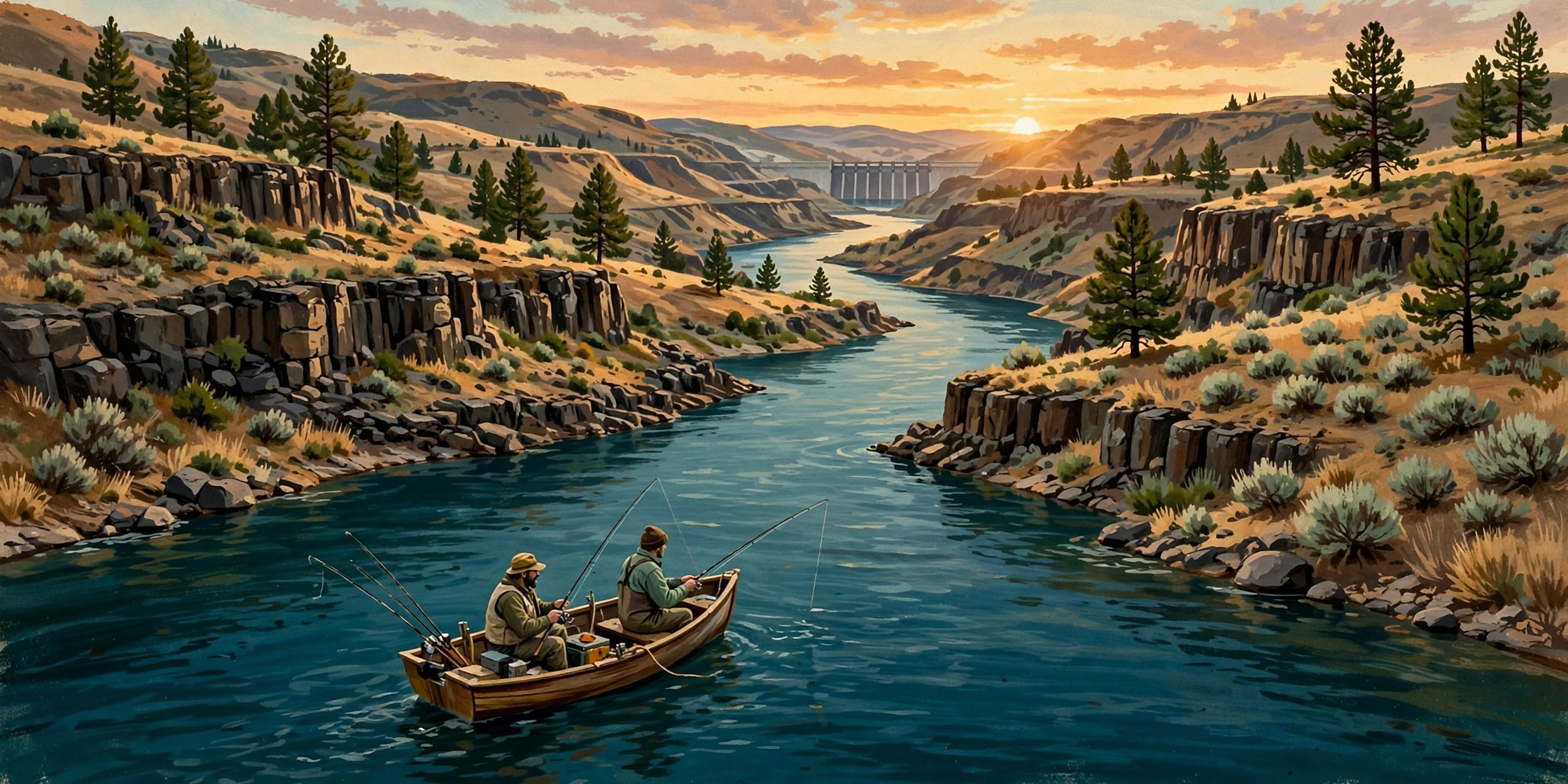
For thousands of years the upper Columbia River ran free through this country, and its salmon runs fed the Spokane, Colville, and other tribes of the plateau. Kettle Falls — where the river poured over a series of ledges — was one of the great Indigenous fisheries of the Northwest, a place of harvest, trade and ceremony each salmon season.
That river ended in the 1930s. Grand Coulee Dam, built by the U.S. Bureau of Reclamation between 1933 and 1942 as a New Deal public-works project, rose 550 feet above bedrock — one of the largest concrete structures on earth — and backed the Columbia up for roughly 150 miles, all the way to the Canadian border. The reservoir was named for President Franklin D. Roosevelt. The rising water drowned Kettle Falls in 1940; the tribes held a "Ceremony of Tears" as the falls went under.
The dam changed everything it touched. It blocked salmon and steelhead from the entire upper Columbia above it — no fish ladder was built — ending the runs that had sustained the river's people and its fisheries for millennia. In their place came a new, resident fishery: the walleye, kokanee, rainbow trout and bass anglers chase today, supported in modern times by hatchery and net-pen programs run with the Spokane Tribe, the Colville Tribes and WDFW.
The dam also remade the land. Its pumps lift Columbia water into the Columbia Basin Project, irrigating hundreds of thousands of acres of central Washington farmland, and its powerhouses — enlarged over the decades, including the Third Powerplant finished in the 1970s — made Grand Coulee the largest power-producing facility in the United States, at roughly 6,800 megawatts.
In 1966 the shoreline became Lake Roosevelt National Recreation Area, managed by the National Park Service: more than 600 miles of shoreline, dozens of campgrounds and launches, and the lake this community fishes. Every spring the Army Corps' flood-control plan and the dam's operators draw the lake down — sometimes 80 feet — then refill it toward full pool (1,290 feet) by early summer, a rhythm every Roosevelt angler learns to fish by.
Fun facts
- Full pool is elevation 1,290 feet; the lake covers about 80,000 acres at full pool.
- Grand Coulee Dam contains roughly 12 million cubic yards of concrete — enough, by the old boast, to build a highway across the country.
- The lake stretches about 150 miles, from Grand Coulee to the Canadian border — one of the longest reservoirs in the West.
- Before the dam, salmon reached all the way into Canada. The blocked upper basin is now managed as a resident-fish system.
- Fort Spokane, at the mouth of the Spokane Arm, began as a U.S. Army outpost in 1880 and later became a boarding school and hospital.
- The dam's spillway, when fully open, can pass more than a million cubic feet of water per second.